How to Replace a Car Battery Safely, Step by Step
Posted by DIYCar Editorial Team Reviewed by DIYCar Editorial Team Review date Posted Topic: Battery
To replace a car battery, work with the engine off and eye protection on, then disconnect the negative cable first and the positive cable second, as one automaker's owner's manual instructs. Fit a new battery with the same group size and terminal layout, clean the cable ends, secure the hold-down, and return the old battery to a retailer for recycling. Your owner's manual decides the details.
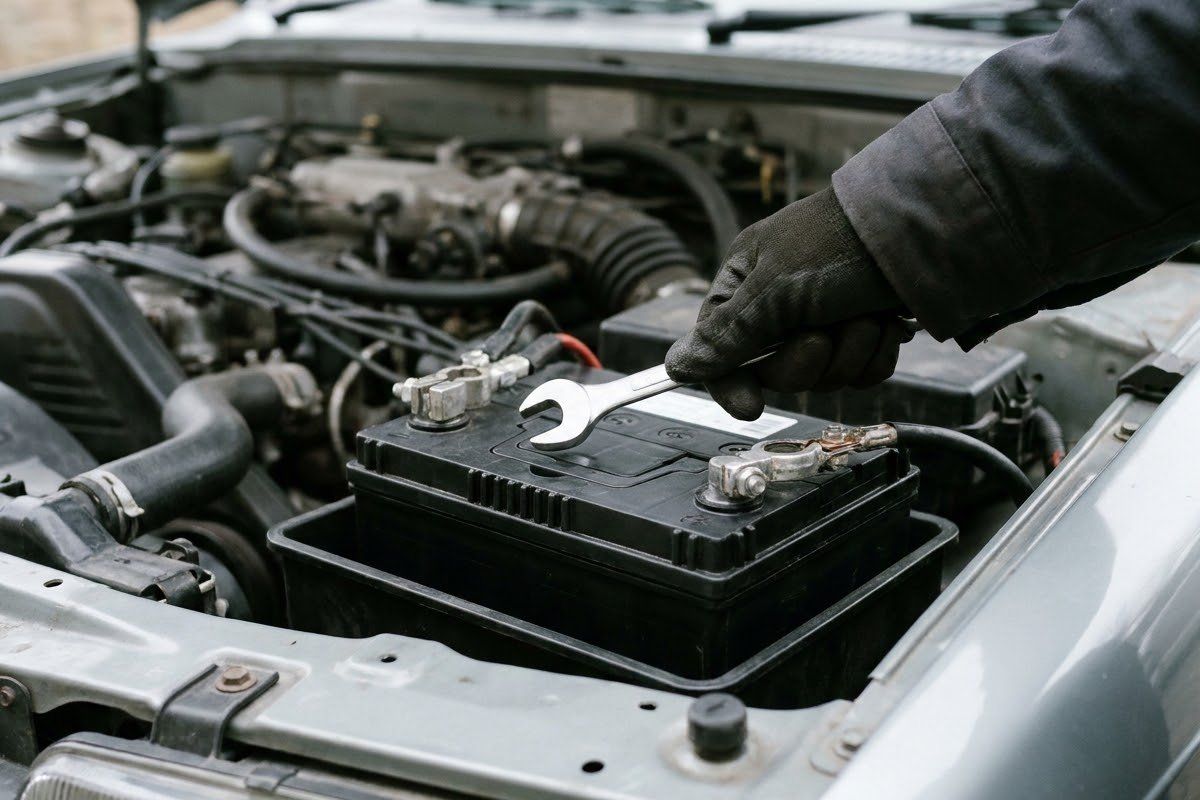
Replacing a car battery is a job many beginners can do with basic hand tools, but only if the car is a simple case and you follow your owner’s manual. This guide covers the sequence, the hazards and the point at which a shop is the better choice. For related decisions see what drives the price, AGM vs flooded battery types and how to charge a car battery. General rules for any job are in safe-work basics.
Before you start: battery hazards and what to wear
A car battery holds corrosive acid and can release explosive gas, so eye protection and a no-spark workspace come first. EPA notes that lead-acid batteries may contain up to 18 pounds of lead and about one gallon of corrosive, lead-contaminated sulfuric acid.
- Acid. OSHA describes battery electrolyte as sulfuric acid that is highly corrosive and could be splashed on anyone servicing or changing batteries.
- Hydrogen. Batteries can give off highly explosive hydrogen fumes, especially toward the end of charging. Keep flames, sparks and smoking away.
- Protective gear. OSHA’s list for battery work is a face shield, safety goggles, neoprene or rubber gloves and an apron. For a car at home, at minimum wear splash-proof eye protection and chemical-resistant gloves.
- Metal. Remove rings, watches and necklaces, and do not set tools on top of the battery, so that metal cannot bridge the terminals.
- Ventilation. Work outdoors or with the garage door open, with the engine off and the key out.
If acid reaches your eyes, one owner’s manual says to flush with clean water for at least 15 minutes and get immediate medical attention. Keep children and pets away from the work area.
Is it the battery? Quick checks before you buy
Confirm the battery is the problem before buying one. Symptoms such as slow cranking or a clicking sound can also come from loose or corroded cable ends or a charging problem. Look for loose clamps, white or blue-green crust on the terminals and cracks or bulges in the case before you spend money. If the case is swollen, leaking or cracked, stop and treat it as a hazard: wear gloves and eye protection and consider having a shop handle it.
Find the right battery from the manual
Match the battery to what your owner’s manual specifies. A BCI group size classifies batteries by voltage, maximum overall dimensions, terminal arrangement and special features that may affect fit. BCI says four things identify a group: physical size (batteries in a group are the same size within 2 mm), performance (cold cranking amps or amp hours), terminal position (it must align with the vehicle cables) and chemistry (lead flooded is the default, with EFB, AGM and LFP designations for other chemistries).
Check these three before buying:
- Group size and terminal layout in your manual or on the old battery’s label.
- Chemistry. Cars with start-stop systems may specify a particular chemistry such as EFB (BCI describes EFB as aimed at start-stop vehicles); follow the manual. See AGM vs flooded vs EFB.
- Cold cranking amps (CCA). BCI defines CCA as the current a new, fully charged battery can deliver at 0 F (-18 C) for 30 seconds while holding at least 7.2 volts on a 12-volt battery. Your manual gives the minimum rating.
Do not substitute a different chemistry, or a lower CCA rating, without the manual’s approval.
Tools and memory-saver notes
Most batteries need a socket or wrench for the clamps and hold-down, a terminal brush or wire brush, gloves and eye protection. A basic tool kit covers it. Disconnecting the battery can reset items on some cars. One owner’s manual lists auto up/down windows, the trip computer and climate control as items to reset after a battery has been disconnected or discharged. Some newer cars need more than a reset; if your manual mentions a battery sensor, registration or a scan-tool step, plan to use a shop.
Step by step: remove and install
Follow the order your manual prints; the sequence below reflects one automaker’s owner’s manual and consumer guidance.
- Park on level ground, set the parking brake, switch everything off and remove the key. Open the hood and locate the battery. Some cars put it in the trunk or under a seat.
- Photograph the connections and note which terminal is positive (+, usually red) and negative (-, usually black).
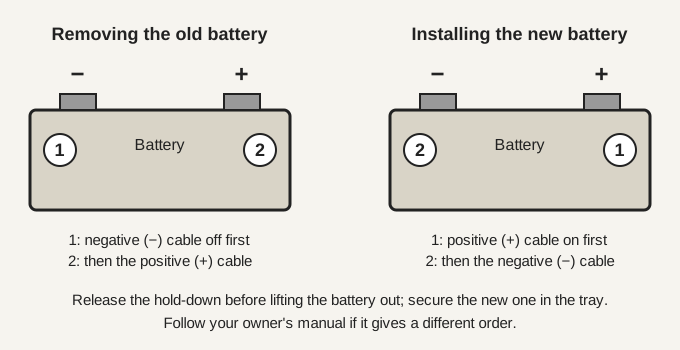
- Disconnect the negative cable first. One owner’s manual says the negative cable must be removed first and installed last. Move the cable end clear so it cannot touch the terminal.
- Disconnect the positive cable second.
- Remove the hold-down and lift the battery straight out. Batteries are heavy and the case can leak; keep it upright.
- Clean the tray, cable clamps and terminal posts. Kia’s consumer guidance says rusty terminals can be cleaned with water, baking soda and a wire brush. Do not let the solution get into the battery or onto your skin.
- Set the new battery in the tray the same way round as the old one.
- Secure the hold-down. The battery must not be able to move.
- Reconnect. Kia’s guidance for a new battery is to connect the positive terminal first and the negative second, which is the reverse of removal. Never touch a metal object to both terminals at once.
- Tighten the clamps until they do not move by hand, without over-tightening the posts. Do not force a clamp on.
After installation, start the car, check for warning lights and test the items your manual says may need resetting.
Clean terminals and secure the hold-down
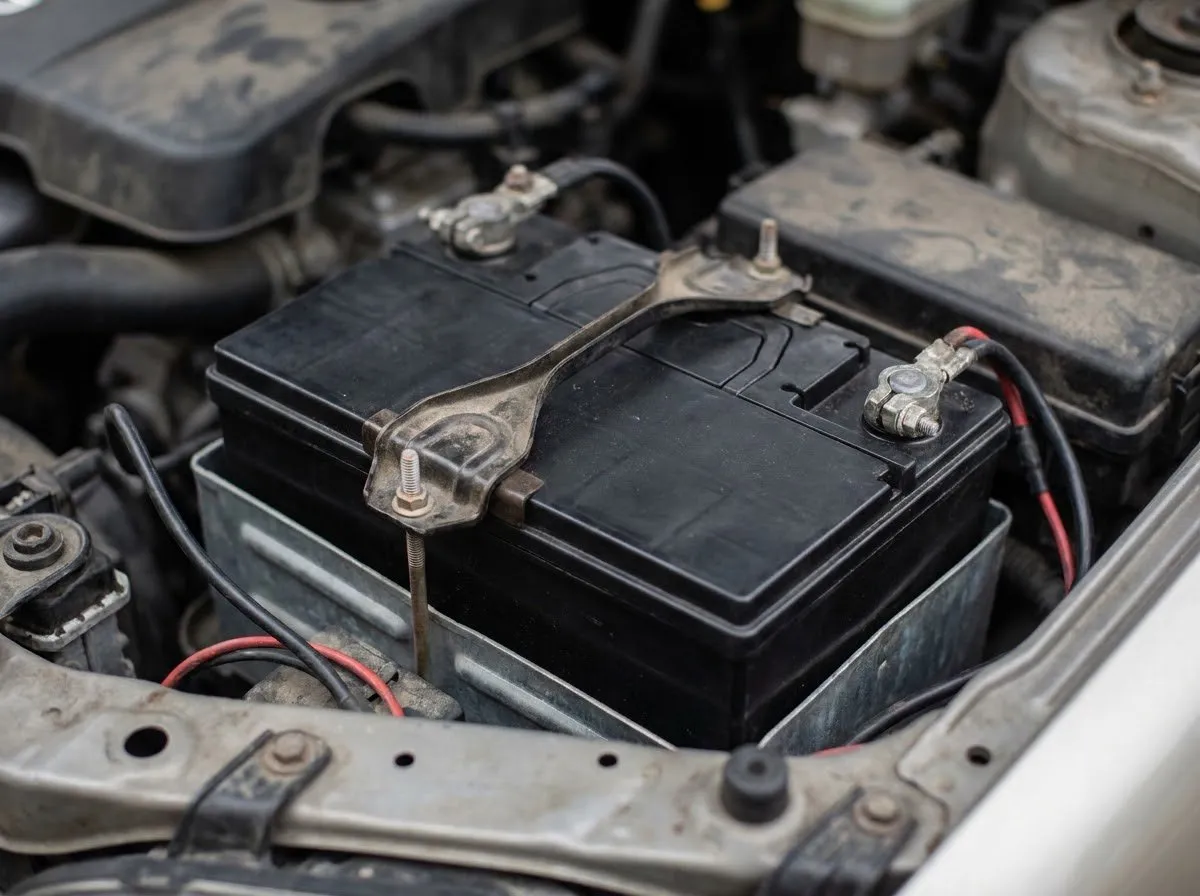
Corroded or loose cable ends are a common reason a good battery seems weak. Brush the posts and clamps until you see bare metal, wipe them dry, and make sure the clamps seat fully. A loose hold-down lets the battery vibrate, so check that it is tight before closing the hood.
Disposal and core return
Take the old battery to a retailer or a household hazardous waste program. EPA’s guidance is to return lead-acid batteries to a battery retailer or local household hazardous waste collection program and not to put them in the trash or municipal recycling bins. BCI reports a 98% U.S. recycling rate for lead batteries in its 2026 study. Carry the old battery upright in a container that cannot leak. Ask the seller about any return credit or fee, as policies and state laws vary.
When to hand it to a shop
Use a shop in any of these cases:
- The car is a hybrid or electric vehicle, or you would need to work near orange high-voltage cables.
- The battery is in the trunk, under a seat or behind panels, and your manual calls for special steps or tools.
- Your manual mentions battery registration, a battery sensor or a scan-tool step after replacement.
- The case is cracked, swollen, leaking or very corroded, or the cable clamps will not come off cleanly.
- A fastener is stripped, seized or damaged.
- You smell fuel or see signs of an electrical fire hazard such as melted insulation.
- You are not sure which cables go where.
Related reading: how to charge a car battery, what drives the price and the maintenance checklist.
All Battery guides
- Car Battery Replacement Cost: What Drives the Price
What decides car battery replacement cost: size, chemistry, labor, return credits and warranty, plus a checklist for comparing quotes. No made-up prices.
- Car Battery Types: AGM vs Flooded vs EFB, Explained
Compare flooded, EFB and AGM car batteries: how each is built, what group size, CCA and reserve capacity mean, and where to find your car's required type.
- How to Charge a Car Battery Safely With a Charger
Charge a car battery safely with a charger: ventilation, clamp order, charger settings, how to tell it is done, and when the battery is beyond saving.
Quick answers
Which terminal do I disconnect first?
Disconnect the negative cable first, then the positive. One automaker's owner's manual states that the negative battery cable must be removed first and installed last. The same maker's consumer guidance says to connect the positive terminal first on the new battery, then the negative. Because vehicles differ, follow the order printed in your own owner's manual, and never let a metal tool touch both terminals at once.
Do I need to reset anything after replacing the battery?
Possibly. One owner's manual lists auto up/down windows, the trip computer and the climate control system as items to reset after a battery has been disconnected or discharged, so check which items your car needs. Your manual lists what your car needs. If it mentions battery registration or a battery sensor, have a shop do that step.
How long does it take?
No source we cite gives a standard time, and it depends on where the battery sits, how corroded the cables are and how many hold-down parts there are. Allow time to work slowly: rushing is how tools short across terminals. If the battery is under a seat, in the trunk or behind panels, expect the job to take longer and consider a shop.
Can I replace the battery on a hybrid?
Treat hybrids and electric vehicles with extra caution. They have a separate high-voltage system that must never be touched, and some also use a small 12-volt battery in an unusual location. Do not work near orange high-voltage cables or components. Read the 12-volt battery section of your owner's manual first, and if it directs you to a dealer or shop, follow it.
What do I do with the old battery?
Return it to a battery retailer or a household hazardous waste collection program. EPA says not to put lead-acid batteries in the trash or municipal recycling bins, because they contain lead and sulfuric acid. Keep the old battery upright in a sturdy container while you transport it, and ask the seller whether returning it affects the price you pay.
What if the new battery does not fit or the terminals are on the wrong side?
Do not force it. Group size covers dimensions, terminal arrangement and special features, so a battery with the right size but the wrong terminal layout may leave the cables unable to reach. Compare the new battery to the old one and to the group size in your manual before installing, and return it unused if it does not match.
Where we got this
- EPA: Used Household Batteries (epa.gov)
- EPA: How Do I Recycle Common Recyclables (epa.gov)
- Battery Council International: BCI Group Sizes (batterycouncil.org)
- Battery Council International: Glossary of Battery Terms (batterycouncil.org)
- OSHA eTool: Powered Industrial Trucks, Electric Power Sources (battery hazards) (osha.gov)
- Kia owner's manual: Battery (ownersmanual.kia.com)
- Kia: Which car battery terminal to connect first? (kia.com)
Further guides
- Car Battery Replacement Cost: What Drives the Price
What decides car battery replacement cost: size, chemistry, labor, return credits and warranty, plus a checklist for comparing quotes. No made-up prices.
- Car Battery Types: AGM vs Flooded vs EFB, Explained
Compare flooded, EFB and AGM car batteries: how each is built, what group size, CCA and reserve capacity mean, and where to find your car's required type.
- How to Charge a Car Battery Safely With a Charger
Charge a car battery safely with a charger: ventilation, clamp order, charger settings, how to tell it is done, and when the battery is beyond saving.