How to Jack Up a Car Safely: Jack Points, Stands and Ramps
Posted by DIYCar Editorial Team Reviewed by DIYCar Editorial Team Review date Posted Topic: Oil and Basics
To jack up a car safely, park on firm level ground, find the jack points in your owner's manual, lift only at those points, then support the car on jack stands or ramps before any part of you goes under it. A jack alone is never safe to work under. Lower slowly and remove stands only after you are clear.
Section of: DIY Car Safety: The Rules Before You Touch Anything
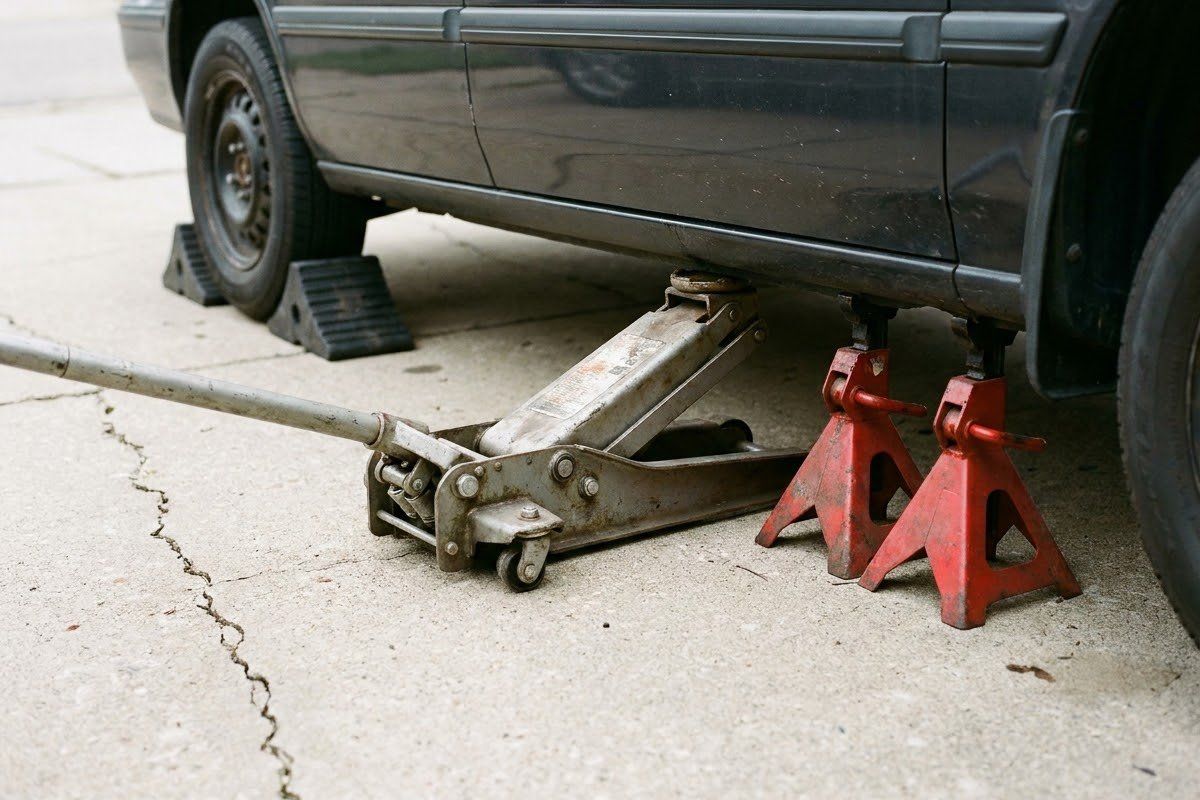
A jack lifts a car and nothing more. The rule that matters on this page is the one every manual states: support the car on stands or ramps before you go under it. It is part of our DIY car safety rules, and it applies to the oil change walkthrough, the tire rotation and any other job that needs the car raised.
Why a jack alone is never enough
A car held by a jack alone can fall. One maker’s manual says: “Do not get under a vehicle that is supported by a jack,” and “Do not place any portion of your body under a vehicle that is only supported by a jack.” The supplied jack is described there as provided for emergency tire changing only, and the manual says not to start or run the engine while the vehicle is on the jack. Lift with the jack, then support with stands.
Where the jack points are: use the manual’s diagram
Lift only at the points your owner’s manual shows. The manual we cite says to be sure to use the correct front and rear jacking positions on the vehicle. If you cannot find them, look in the manual’s index under “jacking” or “lifting”, or use a shop.
Jack stands: what to check
- Use stands that are made for supporting vehicles, with a rating marked on them. Check the rating against your vehicle’s weight.
- Inspect them before each use. Do not use a stand that is bent, cracked, welded or damaged, or whose locking mechanism does not engage.
- Use stands in pairs, and place them at the support points your manual shows or the maker’s lifting diagram indicates.
Level, solid ground
The manual we cite says to use the jack on firm level ground. Do not lift on a slope, on soft ground or on a surface that may shift. Set the parking brake, put the car in park or in gear as your manual describes, and chock the wheels that stay on the ground (the manual page we cite does not cover chocks, so follow your own manual’s wheel-chock and jacking instructions).
Step by step: lift, support, test, then work
- Park on firm level ground, set the parking brake, chock the wheels that stay down, and make sure nobody is in the car.
- Find the lift point in your manual and position the jack under it.
- Raise the car slowly, only as high as the job needs.
- Place the stands under the support points, then lower the car slowly until its weight rests on the stands.
- Leave the jack in place, lightly loaded, as a backup if it will not interfere.
- Before you go under, push firmly on the car from the side. If it moves or rocks, lower it and start again.
Ramps vs stands
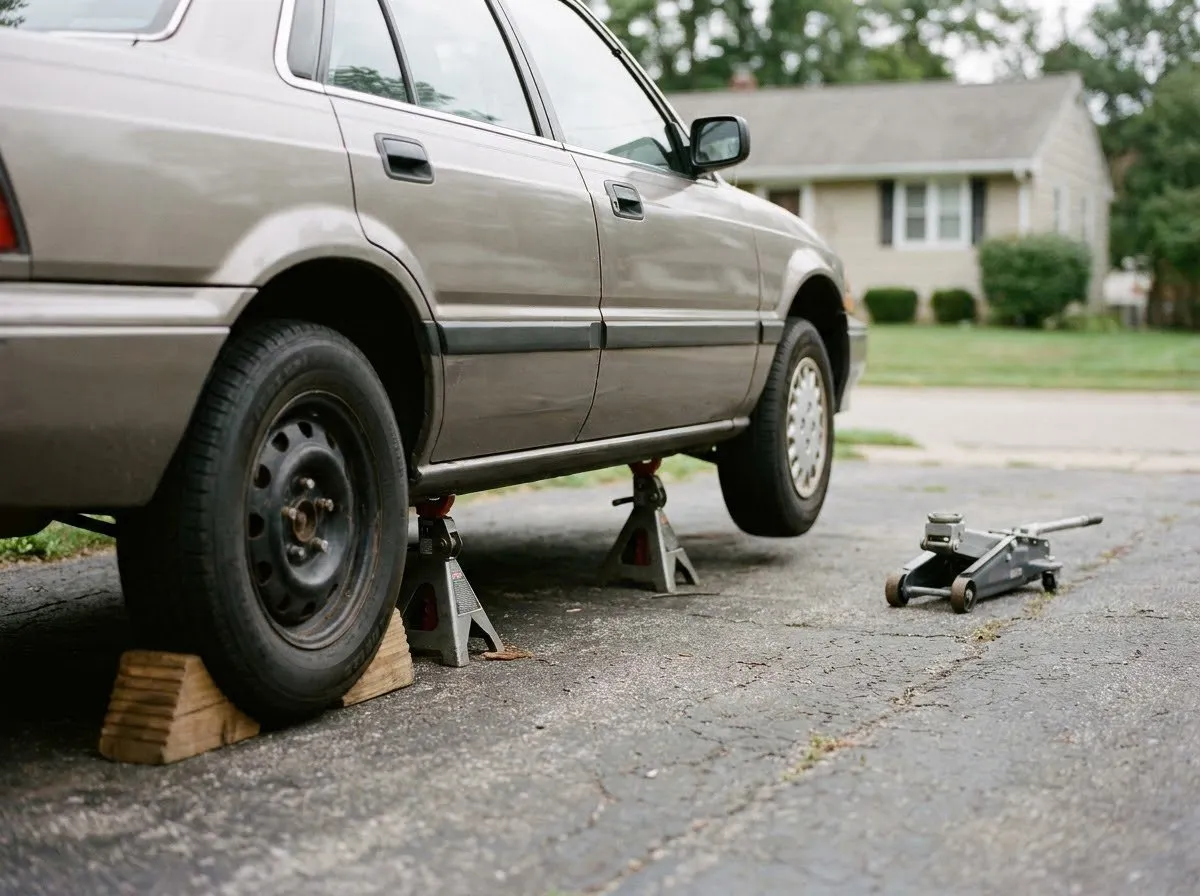
Ramps support the car by its tires, so they suit jobs that do not need the wheels off, such as an oil change. Drive on slowly and straight, set the parking brake, and chock the wheels on the ground. Use ramps rated for your vehicle, and check the instructions that came with them. See changing oil yourself for a job where ramps are typical.
Lowering and removing
Clear all tools and people from under the car, raise it slightly off the stands, remove them, and lower the car slowly. Take the chocks out last.
Never do this
- Never get under a car held only by a jack.
- Never leave anyone in the car while it is on a jack.
- Never lift on soft, sloping or uneven ground.
- Never use anything other than rated stands or ramps to support the car.
- Never lift at points that are not in your manual.
Gather the right gear first: the basic tool kit. If you plan a tire rotation, read how to rotate tires, and if the job needs more oil, see how many quarts of oil. The maintenance schedule overview shows which jobs need the car raised.
Quick answers
Can I use cinder blocks instead of jack stands?
No. The manual we cite says to use vehicle support stands, which are equipment made for the job. Do not improvise with blocks, bricks, wood stacks or the jack itself. Buy a pair of stands whose rating is marked on them and suits your vehicle, or use ramps made for cars, and follow the maker's instructions for each.
How high should I lift the car?
Only as high as the job needs. The higher the car, the less stable it is on the jack, and the harder it is to work safely. Lift just enough to place the stands at the points your manual shows, then lower the car gently onto them rather than leaving it on the jack.
Can I jack a car on asphalt in summer?
The manual we cite says to use the jack on firm level ground. If a surface might be soft, uneven or sloped, do not jack on it. Move to concrete or another hard level surface. If you cannot find one, do not lift the car; use a shop. The jack and stand bases must not be able to sink or slide.
Can I use the jack that came with the car for repairs?
The jack supplied with a car is meant for emergency tire changes; one manual describes it as provided for emergency tire changing only. For maintenance, use a floor jack, then support the car on stands. Check what your manual says about the supplied jack and where it fits the car's lift points.
Where are the jack points?
They are shown in your owner's manual, usually as a diagram of the front and rear lifting positions. One maker's manual says to be sure to use the correct front and rear jacking positions. Do not guess from the car's look: lifting at the wrong place can damage the car and make it unstable.
Should anyone stay in the car while it is lifted?
No. The manual we cite says not to allow anyone to remain in the vehicle while it is on the jack, and that any children present must be in a secure place away from the road and the vehicle. Keep pets and bystanders clear too. Only the person doing the job should be near the car while it is lifted.
Where we got this
- Kia Owner's Manual: Jacking instructions (ownersmanual.kia.com)
Further guides
- Car Maintenance Checklist: What to Check and When
A car maintenance checklist by system: what to check regularly, which jobs follow your manual's schedule, and which are safe for beginners to do.
- DIY Car Safety: The Rules Before You Touch Anything
DIY car safety rules for beginners: supporting the car, hot fluids, batteries, carbon monoxide, PPE, disposal, and when to stop and call a shop.
- How to Change Oil in a Car: Step-by-Step for Beginners
How to change your own engine oil safely: the manual-first checks, the order of the job, used-oil disposal and when to hand the car to a shop.
- Basic Tool Kit for Car Maintenance: What a Beginner Needs
A beginner's tool kit for car maintenance: start with the manual and a tire gauge, then sockets, a torque wrench, stands and safety gear. Skip the rest.
- How Many Quarts of Oil Does My Car Need?
How many quarts of oil your car takes is listed in the owner's manual for your exact engine. Where to find it, and how to fill and check the level.
- How Often to Change Oil: What the Manual Says and Why
How often to change oil depends on your owner's manual, your driving conditions and the oil used. See normal vs severe schedules and what to check.